Christian Tragedy in the Muslim World – Human Events reblog

image
by Bruce Thornton, humanevents.com / July 30th 2013

Few people realize that we are today living through the largest persecution of Christians in history, worse even than the famous attacks under ancient Roman emperors like Diocletian and Nero. Estimates of the numbers of Christians under assault range from 100-200 million. According to one estimate, a Christian is martyred every five minutes. And most of this persecution is taking place at the hands of Muslims. Of the top fifty countries persecuting Christians, forty-two have either a Muslim majority or have sizeable Muslim populations.

The extent of this disaster, its origins, and the reasons why it has been met with a shrug by most of the Western media are the topics of Raymond Ibrahim’s Crucified Again. Ibrahim is a Shillman Fellow at the David Horowitz Freedom Center and an associate fellow of the Middle East Forum. Fluent in Arabic, he has been tracking what he calls “one of the most dramatic stories” of our time in the reports and witnesses that appear in Arabic newspapers, news shows, and websites, but that rarely get translated into English or picked up by the Western press. What he documents in this meticulously researched and clearly argued book is a human rights disaster of monumental proportions.

In Crucified Again, Ibrahim performs two invaluable functions for educating people about the new “Great Persecution,” to use the label of the Roman war against Christians. First, he documents hundreds of specific examples from across the Muslim world. By doing so, he shows the extent of the persecution, and forestalls any claims that it is a marginal problem. Additionally, Ibrahim commemorates the forgotten victims, refusing to allow their suffering to be lost because of the indifference or inattention of the media and government officials.

Second, he provides a cogent explanation for why these attacks are concentrated in Muslim nations. In doing so, he corrects the delusional wishful thinking and apologetic spin that mars much of the current discussion of Islamic-inspired violence.

Ibrahim’s copious reports of violence against Christians range across the whole Muslim world, including countries such as Indonesia, which is frequently characterized as “moderate” and “tolerant.” Such attacks are so frequent because they result not just from the jihadists that some Westerners dismiss as “extremists,” but from mobs of ordinary people, and from government policy and laws that discriminate against Christians. Rather than ad hoc reactions to local grievances, then, these attacks reveal a consistent ideology of hatred and contempt that transcends national, geographical, and ethnic differences.

In Afghanistan, for example, where American blood and treasure liberated Afghans from murderous fanatics, a court order in March 2010 led to the destruction of the last Christian church in that country. In Iraq, also free because of America’s sacrifice, half of the Christians have fled; in 2010, Our Lady of Salvation Church in Baghdad was bombed during mass, with fifty-eight killed and hundreds wounded.

In Kuwait, likewise, the beneficiary of American power, the Kuwait City Municipal Council rejected a permit for building a Greek Catholic church. A few years later, a member of parliament said he would submit a law to prohibit all church construction. A delegation of Kuwaitis was then sent to Saudi Arabia––which legally prohibits any Christian worship–– to consult with the Grand Mufti, the highest authority on Islamic law in the birthplace of Islam, the Arabian Peninsula.

The Mufti announced that it is “necessary to destroy all the churches of the region,” a statement ignored in the West until Ibrahim reported it. Imagine the media’s vehement outrage and condemnation if the Pope in Rome had called for the destruction of all the mosques in Italy. The absence of any Western condemnation or even reaction to the Mufti’s statement was stunning. Is there no limit to our tolerance of Islam?

Moreover, it is in Egypt––yet another beneficiary of American money and support–– that the harassment and murder of Christians are particularly intense. Partly this reflects the large number of Coptic Christians, the some sixteen million descendants of the Egyptian Christians who were conquered by Arab armies in 640 A.D. Since the fall of Mubarak, numerous Coptic churches have been attacked by Muslim mobs. Most significant is the destruction of St. George’s church in Edfu in September 2011. Illustrating the continuity of mob violence with government policy, the chief of Edfu’s intelligence unit was observed directing the mob that destroyed the church. The governor who originally approved the permit to renovate the building went on television to announce that the “Copts made a mistake” in seeking to repair the church, “and had to be punished, and Muslims did nothing but set things right.”

The destruction of St. George’s precipitated a Christian protest against government-sanctioned violence against Christians and their churches in the Cairo suburb of Maspero in October 2011. As Muslim mobs attacked the demonstrators to shouts of “Allahu Akbar” and “kill the infidels,” the soldiers sent to keep order helped the attackers. Snipers fired on demonstrators, and armored vehicles ran over several. Despite the gruesome photographs showing the crushed heads of Copts, the Egyptian military denied the charges, but then claimed that Copts had hijacked the vehicles and ran over their co-religionists.

False media reports of Copts murdering soldiers fed the violence. Twenty-eight Christians were killed and several hundred wounded. In the aftermath, thirty-four Copts were retained, including several who had not even been at the demonstration. Later, two Coptic priests had to stand trial. Meanwhile, despite an abundance of video evidence, the Minister of Justice closed an investigation because of a “lack of identification of the culprits.”

The scope of such persecution, the similarity of the attacks, and the attackers’ motives, despite national and ethnic differences, and the role of government officials in abetting them, all cry out for explanation. Ibrahim clearly lays out the historical and theological roots of Muslim intolerance in the book’s most important chapter, “Lost History.” Contrary to the apologists who attribute these attacks to poverty, political oppression, the legacy of colonialism, or the unresolved Israeli-Arab conflict, Ibrahim shows that intolerance of other religions and the use of violence against them reflects traditional Islamic theology and jurisprudence.

First Ibrahim corrects a misconception of history that has abetted this misunderstanding. During the European colonial presence in the Middle East, oppression of Christians and other religious minorities was proscribed. This was also the period in which many Muslims, recognizing how much more powerful the Europeans were than they, began to emulate the political and social mores and institutions of the colonial powers.

Thus they abolished the discriminatory sharia laws that set out how “dhimmis,” the Christians and Jews living under Muslim authority, were to be treated. In 1856, for example, the Ottomans under pressure from the European powers issued a decree that said non-Muslims should be treated equally and guaranteed freedom of worship. This roughly century-long period of relative tolerance Ibrahim calls the Christian “Golden Age” in the Middle East.

Unfortunately, as Ibrahim writes, the century-long flourishing of Middle Eastern Christians “has created chronological confusions and intellectual pitfalls for Westerners” who take the “hundred-year lull in persecution” as the norm. In fact, that century was an anomaly, and after World War I, traditional Islamic attitudes and doctrines began to reassert themselves, a movement that accelerated in the 1970s. The result is the disappearance of Christianity in the land of its birth. In 1900, twenty percent of the Middle East was Christian. Today, less than two percent is.

Having corrected our distorted historical perspective, Ibrahim then lays out the justifying doctrines of Islam that have made such persecution possible during the fourteen centuries of Muslim encounters with non-Muslims. The foundations can be found in the Koran, which Muslims take to be the words of God. There “infidels” are defined as “they who say Allah is one of three” or “Allah is the Christ, [Jesus] son of Mary”––that is, explicitly Christian. As such, according to the Koran, they must be eliminated or subjugated. The most significant verse that guides Muslim treatment of Christians and Jews commands Muslims to wage war against infidels until they are conquered, pay tribute, and acknowledge their humiliation and submission.In the seventh century, the second Caliph, Omar bin al-Khattab, promulgated the “Conditions of Omar” that specified in more detail how Christians should be treated. These conditions proscribe building churches or repairing existing ones, performing religious processions in public, exhibiting crosses, praying near Muslims, proselytizing, and preventing conversion to Islam, in addition to rules governing how Christians dress, comport themselves, and treat Muslims.

“If they refuse this,” Omar said, “it is the sword without leniency.” These rules have consistently determined treatment of Christians for fourteen centuries, and Muslims regularly cite violations of these rules as the justifying motives for their attacks. As a Saudi Sheikh said recently in a mosque sermon, “If they [Christians] violate these conditions, they have no protection.” From Morocco to Indonesia, Christians are attacked and murdered because they allegedly have tried to renovate a church, proselytized among Muslims, or blasphemed against Mohammed––all reasons consistent with Koranic injunctions codified in laws and the curricula of school textbooks.

Both Islamic doctrine and history show the continuity of motive behind today’s persecution of Christians. As Ibrahim writes, “The same exact patterns of persecution are evident from one end of the Islamic world to the other––in lands that do not share the same language, race, or culture––that share only Islam.” But received wisdom in the West today denies this obvious truth. The reasons for this attitude of denial would fill another book. As Ibrahim points out, the corruption of history in the academy and in elementary school textbooks have replaced historical truth with various melodramas in which Western colonialists and imperialists have oppressed Muslims.

These and other prejudices have led American media outlets to ignore or distort Islamic-inspired violence, as can be seen in the coverage of the Nigerian jihadist movement Boko Haram. These jihadists have publicly announced their aim of cleansing Nigeria of Christians and establishing sharia law, yet Western media coverage consistently ignores this aim and casts the conflict as a “cycle of violence” in which both sides are equally guilty.

As Ibrahim concludes, even when Western media report on violence against Christians, “they employ an arsenal of semantic games, key phrases, convenient omissions, and moral relativism” to promote the anti-Western narrative that “Muslim violence and intolerance are products of anything and everything––poverty, political and historical grievances, or territorial disputes––except Islam.”

Within the global Muslim community, there is a civil war between those who want to adapt their faith to the modern world, and those who want to wage war in order to recreate a lost past of Muslim dominance. We do the former no favor by indulging Islam’s more unsavory aspects, since those aspects are exactly what need to be changed if Muslims want to enjoy the freedom and prosperity that come from political orders founded on human rights and inclusive tolerance. Raymond Ibrahim’s Crucified Again is an invaluable resource for telling the truth that could promote such change.

Bruce S. Thornton is a research fellow at the Hoover Institution.
Will Coptic Christians Share in the Arab Spring While Morsi Is President of Egypt? – Re-Blog

By Michael Terheyden / 6/22/2013
Catholic Online (www.catholic.org)

Is it really a Spring at all, or a frightening return of an worse Winter?

https://www.youtube.com/watch?v=Rnhh9Vt2xwE&feature=youtube_gdata_player

As the one year anniversary of the election of Egypt’s President Mohamed Morsi approaches, tensions are high. Tens of thousands of Islamists have begun pouring into Cairo in anticipation of anti-Morsi demonstrations planned for June 30, 2013, by opponents of the new government.

image

KNOXVILLE, TN (Catholic Online) – As the one year anniversary of the election of Egypt’s President Mohamed Morsi approaches, tensions are high. Tens of thousands of Islamists have begun pouring into Cairo in anticipation of anti-Morsi demonstrations planned for June 30, 2013, by opponents of the new government.

image
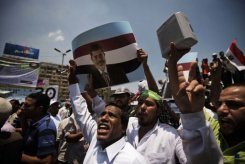
Egyptian Islamists led by the ruling Muslim Brotherhood shout slogans during a demonstration on June 21, 2013 in Cairo to mark the upcoming one year anniversary since President Mohamed Morsi's election. Tens of thousands of Islamists gathered for a show of strength ahead of planned opposition protests against Morsi, highlighting the tense political divide in the Arab world's most populous state.

According to France 24, an international news site, Islamists carrying Egyptian flags and pictures of Morsi held a demonstration on Friday, June 21. It was led by the Muslim Brotherhood, and its aim was to show that Morsi and his government had the support of the Egyptian people. But the Egyptian people are clearly divided.

Morsi was elected one year ago, after the fall of President Hosni Mubarak in February of 2011. Morsi promised to be the President of all Egyptians, including the Coptic Christian community. He said the Copts would be given full equal rights. At one point Morsi said,  “I will not be biased against any son of Egypt.” But this is not what has happened.

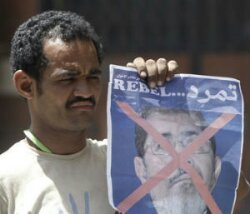
Instead, it appears that Morsi has used every opportunity to turn Egypt into an Islamist state since he became president. This past November, President Morsi issued a declaration giving himself sweeping dictatorial-style power over the drafting of Egypt’s new constitution. The President’s actions unleashed a firestorm.

A group of judges said, “The state of law is at stake.” The Vice-President of the Supreme Constitutional Court, Tahani al-Gebali, said that Morsi was now an “illegitimate president.” And Mohamed ElBaradei, a Nobel Peace Prize winner, said, “Morsi today usurped all state powers and appointed himself Egypt’s new pharaoh.”

Protestors marched on the presidential palace in Cairo and clashed with supporters of the Muslim Brotherhood. At one point, an estimated 200,000 anti-Morsi protestors flooded into Cairo’s famous Tahrir Square.

President Morsi seemingly backed down, but the final Constitution was drafted by a committee dominated by Islamists who used the Constitution to strengthen sharia law. Sharia law highly discriminates against non-Muslims and women.

Since taking office, Morsi has also had run-ins with the national judiciary, the media and the police. More recently, Morsi appointed seven members of the Muslim Brotherhood as provincial governors. He also gave the Luxor governorship to a member of the militant Islamist group responsible for the massacre of 58 foreign tourists in 1997. These appointments led to several clashes between Morsi’s supporters and his opponents.

According to his opponents, Morsi is “giving the Islamists a monopoly over public institutions.” However, the president’s supporters claim he is merely cleaning up corrupt institutions from the days of Mubarak.

Yet, organizers of the June 30 demonstration say they have collected 15 million signatures on a petition which demands the resignation of Morsi. Nevertheless, Ahmed Aqila, a representative of the Muslim Brotherhood Freedom and Justice Party, does not believe it can happen. He said, “Those who say ‘President Morsi will be toppled on June 30’ live in an illusion they must give up.”

The Coptic Christian community has been concerned that the Morsi government is allowing Islamists to act more aggressively toward non-Muslims. Heba Morayef, a director for Regional Human Rights Watch, says that some Muslims are using more discriminatory language on television. He says, “It’s very scary because of the sudden uptick in violence, compounded by the fact that the Muslim Brotherhood has in no way tried to reign it back and has at times participated.”

For instance, a member of the Muslim Brotherhood, Safwat Hegazi, recalling demonstrations last December which turned violent, told the Copts, “You share this country with us, but there are red lines, and one red line is the legitimacy of Dr. Morsi. Whoever splashes water on that, we will spill his blood.” Hegazi has since been appointed to the National Council on Human Rights in Egypt.

Consequently, some people are nervous about the upcoming demonstration scheduled at the end of this month and with good reason. There is much at stake. Coptic Christians and women have the most to lose, but so too do all Muslims, especially more moderate and secular Muslims.

While spokesmen from both sides are rightly calling for calm, they also realize that people have a right to address the Morsi government. Although he did not officially endorse the upcoming demonstration, according to one source, Pope Tawadros II of the Coptic Orthodox Church said, “Members of Egypt’s Christian minority are free to express their opinions on the streets, just as they were to vote for whomever candidate they supported in the past presidential elections.”

That is the way it should be in a true democracy, and President Morsi knows it. After one of the demonstrations last year, he said, “I will protect for my brothers in the opposition all their rights so they can exercise their role.” Now Morsi needs to prove it. Is Egypt a true democracy or not? Will Egypt’s Coptic Christians ever share in the Arab Spring, or was it a lie? We shall find out at the end of the month.
Let us pray for the safety of our brave brethren who will be demonstrating on June 30, and for a free Egypt where all Egyptians can live in peace. They are not alone. They are merely on the front lines of a battle that is threatening to engulf Christians throughout the world.
________________

Michael Terheyden was born into a Catholic family, but that is not why he is a Catholic. He is a Catholic because he believes that truth is real, that it is beautiful and good, and that the fullness of truth is in the Catholic Church. However, he knows that God’s grace operating throughout his life is the main reason he is a Catholic. He is greatly blessed to share his faith and his life with his beautiful wife, Dorothy. They have four grown children and three grandchildren.

Culture Clash (Ataturk vs Erdogan) – Britons warned to steer clear of Turkey – Daily Mail Re-Blog

Britons warned to steer clear of Turkey as 1,700 protesters arrested after riots rock the country for a third day

  • Protests erupted again today against Turkey’s conservative government
  • Thousands took to the streets in rallies and demonstrations in three cities
  • Britons warned to avoid all but essential travel to parts of Turkey

By SUZANNAH HILLS

PUBLISHED: 11:24 EST, 2 June 2013 | UPDATED: 05:36 EST, 3 June 2013

Tens of thousands took to the streets in the country’s four biggest cities yesterday – the third day of anti-government protests – with demonstrators clashing with riot police, who repelled them with tear gas.

The unrest initially erupted on Friday when trees were torn down at a park in Istanbul’s main Taksim Square under government plans to redevelop the area. But they have widened into a broad show of defiance against the Islamist-rooted Justice and Development Party (AKP).

Scroll down for video

Blaze: An anti-government protester holds Turkey's national flag with a portrait of Mustafa Kemal Ataturk on it Blaze: An anti-government protester holds Turkey’s national flag with a portrait of Mustafa Kemal Ataturk on it
Gas: Police use water cannon as protesters run to avoid tear gas during the third day Gas: Police use water cannon as protesters run to avoid tear gas during the third day
Choke: Turkey's prime minister Recep Tayyip Erdogan rejected claims that he is a 'dictator,' dismissing protesters as an extremist fringeChoke: Turkey’s prime minister Recep Tayyip Erdogan rejected claims that he is a ‘dictator,’ dismissing protesters as an extremist fringe
Riot: A protester falls down as he tries to throw back at police a tear gas canister Riot: A protester falls down as he tries to throw back at police a tear gas canister
Prime minister Recep Tayyip Erdogan blamed the main secular opposition party for inciting the crowds, and said the protests were aimed at depriving his ruling AK Party of votes as elections begin next year.

Erdogan said the plans to remake the square, long an iconic rallying point for mass demonstrations, would go ahead, including the construction of a new mosque and the rebuilding of a replica Ottoman-era barracks.

TURKEY: Mangled vehicles on the streets following two nights of…

And he said the protests – which were started by a small group of environmental campaigners but mushroomed when police used force to eject them from the park on Taksim Square – had nothing to do with the plans. Continue reading “Culture Clash (Ataturk vs Erdogan) – Britons warned to steer clear of Turkey – Daily Mail Re-Blog”

Please pray for Nigerian Christians – World Watch List #13

Persecuted Church: Nigeria North – World Watch List #13 (Open Doors UK)

map_nigeriaPopulation: 166.6 million (88 million Christians)
Main Religion: Islam
Source of Persecution: Islamic extremism

The Islamist agenda to bring Nigeria under the ‘House of Islam’ versus the election of a southern Christian as President has caused much unrest. The Islamist group, Boko Haram, has claimed the lives of at least 800 Christians. The decisions of local government, especially in the twelve northern Sharia states, mean that Christians experience restrictions in schooling, threats of abduction, forced marriage, as well as denial of employment, clean water and healthcare. It is dangerous to convert and for churches to integrate new converts.

Nigeria 1Please Pray:

  • Give thanks that believers are responding to recent pressure with increased prayer, evangelism and care for Muslim Background Believers
  • That Christian youths will resist the temptation to respond with violence to Muslim attacks
  • For Open Doors workers providing emergency support and trauma counseling to victims of attacks.

Religious_and_Ethnic_map_of_NigeriaPersecution dynamics

The pattern of persecution in Nigeria is complex, especially for the twelve northern Sharia states, where local government and social groups leave hardly any space for Christians to live their own lives.

Conversion is dangerous and Muslim-background believers and Christians in many northern states suffer restrictions in schooling, threats of abduction and forced marriage. They have also been denied employment and facilities such as clean water, clinics and roads. It is very difficult for churches to openly integrate new converts from Islam.

Persecution levels vary across the country and are underlined by terrorist action and an unpredictable environment, which leaves Christians living in fear. Continue reading “Please pray for Nigerian Christians – World Watch List #13”

Egypt Update: “Eat less.” – David Goldman Re-Blog

Peanut Gallery: Egypt has a huge food shortage problem – it imports about half its food and is rapidly running out of money.

breadline in Egypt
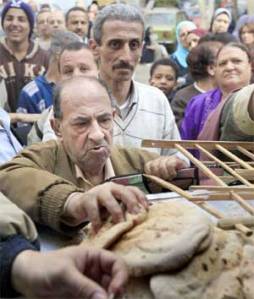
TO HAVE IT IS TO LIVE: The Government sent shockwaves across the nation when a Cabinet minister disclosed a plan to offer every Egyptian just three loaves of the baladi (round) bread every day at the state-subsidised price.

A state that can’t feed its people is a failed state, and that’s why the Egyptian state is at the brink of collapse, as Egypt’s defense minister warned last week.

The Islamists didn’t cause the problem… it’s been coming on for years (as David Goldman has documented). But now they own it because they’re in charge.  And it’s not going away any time in the forseeable future.

Goldman’s latest article brings us up to date. It’s a sad state of affairs for the 40+ million Egyptians living on less than $2 a day.
______________________________

“Eat Less, Egypt’s Government Tells Its People” by David P. Goldman

“Even Islamists have to eat,” I wrote under the headline “Food and Failed Arab States” in February 2011. Egypt’s Muslim Brotherhood government takes a different view, the Washington Post reported yesterday. The trouble, the government says, is that Egyptians are eating too much. In a separate report, the government proposed to cut back its bread subsidy to three hand-sized loaves of pita bread per person per day, about 400 calories’ worth. A state that can’t feed its people is a failed state, and that’s why the Egyptian state is at the brink of collapse, as Egypt’s defense minister warned last week.

According to the Post report, the government is telling Egyptians (almost half of whom live on less than $2 a day) to eat less. You can’t make this sort of thing up. Egypt lost another $1.4 billion in foreign exchange reserves in January, and probably is flat broke after figuring in arrears to oil and food suppliers, and it imports half its food, so something had to give. In response, Egypt’s Islamist government is emulating North Korea’s approach to food shortages: Continue reading “Egypt Update: “Eat less.” – David Goldman Re-Blog”