The pounding on the door was followed by the sound of men yelling for Habila to come out with his family.
Habila rushed to get dressed. When he entered the front room with his wife, Vivian, and their young son close behind, he faced intruders wearing robes and masks. One was armed with an AK-47. Habila said a short prayer to the Lord.
After announcing that they were there to do the work of Allah, the men began to question Habila. They asked him his name, his profession, whether he was a policeman or in the military, and whether he was a Christian or Muslim.
“I am a Christian,” he replied.
Vivian was terrified, knowing the men were members of Boko Haram.
The intruders told Habila that they were giving him the opportunity to live—and live a better life—if he would only become a Muslim and say the shahada [Islamic profession of faith that includes, “There is no god but Allah, and Muhammad is his messenger”]. They even asked him to join them as a member of Boko Haram.
All the while, Habila was prepared to die. “I am a Christian and will always remain a Christian,” he replied, “even to death.”
“It would indeed be awful to think,” Rabbi Jonathan Sacks said, “that the West might remain silent as violence rages purely out of a failure to recognize that Christians can be victimized, or out of a reluctance to cast aspersions on certain brands of Islam. It would make this the first genocide in history to be tolerated out of social awkwardness.”
__________
Iraqi Christians are being forced to flee Mosul or be put to death. It’s the start of a campaign of genocide. Leave with nothing or die.
Many colleges and universities open the new academic year with a special assembly or convocation that is generally an upbeat occasion of welcome and new beginnings. The Catholic University of America held such an event several days ago, and it included, appropriately enough, a beautiful mass led by Washington’s Cardinal Donald W. Wuerl. The music was sublime and the liturgy well ordered. Dr. John Garvey, the president of CUA, was presented with an award by the Archdiocese of Washington. It was an altogether appropriate and uplifting event. But just before the dismissal, the tone was changed as Cardinal Wuerl, speaking without notes, delivered this admonition with a sense of urgency:
We hear so much today of the word solidarity. It has become a part of our vocabulary in the past twenty or thirty years. Today our solidarity with brothers and sisters of our faith, and of other faiths, in a part of the world where there is clearly an effort to eliminate them is something that we simply cannot in conscience ignore. Often we are asked: “How was it possible that in human history atrocities occur?” They occur for two reasons: because there are those prepared to commit them, and then there are those who remain silent. And the actions in Iraq and in Syria today are happening to women, children, men—their displacement not the least. Things happening to them is something that we really are not free to ignore, and sometimes all we have to raise is our voice. . . .
I ask myself: Where are these voices? Where the voices of parliaments and congresses? Where are the voices of campuses? Where are the voices of community leaders? . . . Why a silence?
Kirsten PwersFrank Wolf
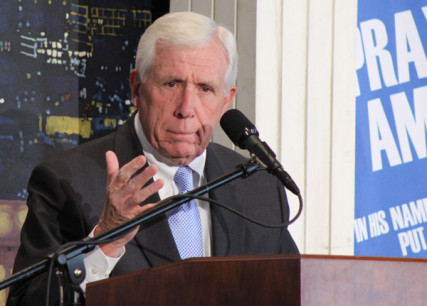
Until quite recently, there were a few—though just a few—who did speak out about the atrocities against Christians and other religious minorities carried out by the Islamic State of Iraq and Syria (ISIS). Back in July, columnist Kirsten Powers referred to the religicide of Christianity in the Middle East: “Iraq’s Christians are begging the world for help. Is anybody listening?” she asked. And there was the estimable Frank Wolf, a member of the House of Representatives from Virginia, who came to the House floor on seven consecutive legislative days to protest the “convert or be killed” policy of Muslim militants in the Middle East. He called on President Obama to take five steps that could have made a difference in that dire situation, none of them involving additional funding or American “boots on the ground.” The response from the leader of the free world, seemingly oblivious to the problem, was an ungolden silence.
Two events in August prompted a growing number of religious and political leaders to begin to speak. One was the onslaught against the Yazidi people, including the abduction and rape of hundreds of Yazidi women and girls, and the stranding of tens of thousands of others on the craggy heights of Mount Sinjar—a humanitarian crisis that prompted limited U. S. airstrikes against ISIS. The other event was a 4-minute, 40-second video depicting the beheading of American journalist James Foley, a devout Catholic, who was brutally put to death at the hands of a jihadist-export from Great Britain. This gruesome video was flashed around the world on YouTube before it was taken down. Last week the serial beheadings continued with the taped execution of 31-year-old Steven Sotloff, a Jewish journalist from Miami and the grandson of Holocaust survivors. Today, we live with another ISIS threat: This time, the promised murder of a British hostage.
“Crimes against humanity” is a euphemism for the wanton killing and horrendous acts of evil being committed in the name of God in the region of the world that gave birth to Judaism, Christianity, and Islam. And yet it is not difficult to see why many thoughtful people are reluctant to encourage yet another military occupation in the region. Twenty-five years of the off-and-on Bush-Obama land wars in Asia have not made the streets of Baghdad safe, nor brought peace between Israel and her neighbors, nor eradicated the virulence of religious violence. ISIS itself was spawned in part through America’s ambivalent connivance in the recent (and ongoing) sectarian wars in Syria where some 200,000 people have been killed and more than 6.5 million others internally displaced or exiled. Libya is yet another country where the quick-fix use of force without a sustainable strategy has not alleviated but rather increased human suffering.
And yet—and yet—there are times in human history when persons of faith cannot play neutral or simply stand by on the sidelines. There are times when they are compelled by conscience to call evil by name and speak out against it with conviction. And they must do this not merely out of a concern for their own personal or national self-protection but precisely as persons of faith—in the name of decency and love and of all that is human and humane. Today is such a time.
Pope Francis
The sentiments expressed by Cardinal Wuerl have been taken up in recent days by many of the world’s religious leaders. Pope Francis has offered to undertake a personal peace mission to northern Iraq. Pastor Rick Warren spoke to the crisis from Rwanda, a country where, in the course of just three months in 1994, genocide left one million Rwandans dead and one million children orphaned—while most of the world looked the other way. Warren said that there were lessons from Rwanda for the crisis in the Middle East. He encouraged African pastors to pray for the persecuted Christians in Iraq and Syria.
Rabbi Jonathan Sacks has called radical political Islam the “face of tyranny” today and has compared the suffering of Christians in the Middle East with violence against Jews in the past. “It would indeed be awful to think,” he said, “that the West might remain silent as violence rages purely out of a failure to recognize that Christians can be victimized, or out of a reluctance to cast aspersions on certain brands of Islam. It would make this the first genocide in history to be tolerated out of social awkwardness.” Some Muslim leaders have also felt it their duty to speak out, including Shawki Ibrahim Abdel-Karim Allam, the Grand Mufti of Egypt. He has said that ISIS is a danger to Islam and has accused it of violating “all the Islamic values, the higher objectives of Islamic law as well as universal values shared by all mankind.”
The Church of England has demanded that the British government offers sanctuary to thousands of Christians fleeing jihadists in northern Iraq, warning that ignoring their plight would constitute a “betrayal of Britain’s moral and historical obligations”.
Justin Welby, the Archbishop of Canterbury, has called for “solidarity of prayer and love” with the Christians in Iraq. “Ever since the war to end all wars ended in 1918, humankind has been saying ‘never again,’ then we wring our hands as genocide unfolds in some distant corner. But what is happening right now in northern Iraq is off the scale of human horror. In a globalized world where even distant nations are our ‘neighbor,’ we cannot allow these atrocities to be unleashed with impunity. . . . We cry to God for peace and justice and security throughout the world, and especially for Christians and other minority groups suffering so deeply in northern Iraq.”
Perhaps no one has done more to alert the world of the atrocities carried out in Iraq and Syria than Canon Andrew White, the Vicar of St. George’s Cathedral in Baghdad. In his 2013 book, Father, Forgive, he wrote:
The sad fact is, religion is very much tied up with violence. As Archbishop William Temple said during the II World War, ‘When religion goes wrong, it goes very wrong.’ The apostle John, recording the words of Jesus in his gospel wrote, ‘the time is coming when anyone who kills you will think they are offering a service to God. They will do such things because they have not known the Father or me’ (John 16:2-3). This is what we have witnessed in our time.
In the midst of such distress, Canon White carries on a ministry of reconciliation and hope among the dwindling number of Christians who still remain in the region. “Here our people have nothing, most have lost everything, yet the presence of Jesus is so real. We talk about love all the time and in love we see the beginning of reconciliation.”
Cardinal Wuerl was right: Atrocities happen because there are those who commit them, and those who simply remain silent. Dietrich Bonhoeffer, whose own life ended on the gallows, knew this very well. “Silence in the face of evil,” he said, “is evil itself. God will not hold us guiltless. Not to speak is to speak. Not to act is to act.”
Timothy George is dean of Beeson Divinity School of Samford University and general editor of the Reformation Commentary on Scripture. His email address is tfgeorge@samford.edu.
Members of Seoul USA launch a 40-foot balloon with a cargo of Bibles for North Koreans. (Seoul USA)
On a rainy afternoon last Spring, American pastor Eric Foley and his wife stood in a muddy field near the North Korea border and prayed – their hands clasped to a 40-foot homemade balloon that would carry Bibles to the communist dictatorship’s underground Christians.
“I get choked up, every time, as I let go and watch it take off,” Foley told FoxNews.com.
The balloons, made from a large sheet of “farm plastic,” said Foley, are filled with hydrogen before the Bibles and “tracts” – testimonials written by other North Korean Christians – are attached at the bottom inside a sack or box. Timers are then used to release the materials in stages, dispersing them at high altitudes across North Korea. Foley and members of his Christian mission group, Seoul USA, use GPS technology to help direct where the Bibles land. Around 50,000 of them have dropped from the skies in the last year.
“They are the most persecuted believers on earth,” Foley said of North Korea’s estimated 100,000 Christians – 30,000 of whom are believed to be locked inside concentration camps, where they are overworked, starved, tortured, and killed. Other activist groups, like Open Doors USA, estimate that number to be even higher, reporting that the secretive nation has about 400,000 Christians.
The balloons are launched from South Korea, and carry the coveted Bibles to North Korea’s estimated 100,000 underground Christians. (Seoul USA)
In North Korea, the practice of Christianity is illegal. Owning a Bible is a crime, and any person caught with one is sent – along with three generations of his or her family – to prison. Foley said despite the risks, demand for Bibles is strong within North Korea. His group targets rural areas where they might be picked up discreetly, he said.
North Koreans are forced to embrace Juche ideology, which mixes Marxism with worship of the late “Great Leader” Kim Il Sung and his family – a warped version of Christianity, says Foley, because Kim took concepts from Christianity, like the Trinity and church hymns, to create a religion in which he is worshipped. Foley said that if North Koreans learned about Christ, they would realize “this is all a fraud.”
“It’s a distortion of Christianity,” Foley said. “And the best way to reach them [North Koreans] is through mindset and knowledge.”
Foley, who is in his late 40s, founded Colorado-based Seoul USA in 2003 with his wife, a South Korean who immigrated to the U.S. in 1984. The two, along with other members of their group, launched their first balloon — strapped with Bibles — from South Korea in 2006. Foley said the balloons are typically sent out overnight from a muddy field at a high altitude between May and October. He said the best conditions are during a “rain storm or really bad weather because of the currents.”
“We are constantly monitoring the wind conditions as we’re launching,” he said, “And the North Korean border is always within the sight line.”
Seoul USA leader the Rev. Eric Foley and members of his group pray before each launch that the Bibles make it to North Korea’s persecuted Christians. (Seoul USA)
The balloons also include tracts, or testimonies, written by other North Korean Christians — some of whom managed to flee to South Korea — about Christ.
“The North Koreans respond very well to story,” Foley explained, “Because all are required to memorize 100 stories” related to Kim’s ideology.
In addition to supplying religious materials by air, Foley’s group produces short-wave radio programs with North Korean defectors reading the Bible. He said about 20 percent of North Koreans own radios, which are illegal.
Foley and his group won the legal rights to conduct the balloon launches from South Korea, but officials there “don’t make it easy,” he said, noting that they often try to force hydrogen suppliers not to sell the group hydrogen.
“Every time we fill up one of these balloons, we hold it and we pray together in English, North Korean and South Korean,” Foley said. “We pray loudly and always with tears.”





 The Peanut Gallery