Update: Egypt’s army issues 48-hour ultimatum to leadership – France24

Egypt’s army issues 48-hour ultimatum to leadership

image
The head of Egypt's armed forces, General Abdel Fattah al-Sisi said the army would remain a 'solid and cohesive block' on which the state could rely. Photograph: AFP/Getty Images

The head of Egypt’s armed forces gave politicians 48 hours to answer demands made by the Egyptian people on Monday, threatening to offer the army’s own “road map for the future” if the protests, which have seen at least six people killed, go ignored.

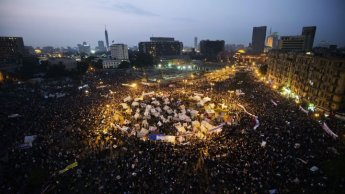
Tens of thousands of Egyptians gathered at Cairo’s Tahrir Square on Monday night welcomed a 48-hour military ultimatum to President Mohammed Morsi and other politicians to resolve the current political crisis or face an intervention.

“Tahrir Square is packed to the gills tonight,” said FRANCE 24’s Kathryn Stapley, reporting from Cairo. “People have come out in the tens of thousands, the streets and side-streets are packed down to the bridges. They’ve been galvanised by the sheer number of people who turned out yesterday as well as the army statement today.”

image
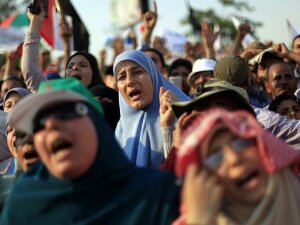
Egyptian opposition protesters chant during a demonstration in Tahrir Square as part of the 'Tamarod' campaign on June 30, 2013 in Cairo. (Ed Giles /AFP/Getty Images)

A day after millions of Egyptians across the country took to the streets urging Morsi’s resignation, the country’s powerful military issued a statement calling on Egypt’s politicians to “meet the demands of the people” within 48 hours or the army would be forced to “announce a roadmap for the future and the steps for overseeing its implementation”.

In the statement, which was broadcast on state television, General Abdel Fattah al-Sisi said the latest protests reflected an “unprecedented” expression of popular anger against Morsi.

The declaration was met with delight on the streets of Cairo, where protesters cheered, honked their car horns and waved flags as army helicopters hovered over Tahrir Square, dropping Egyptian flags on the protesters. “Come down Sisi, Morsi is not my president,” protesters chanted, urging the country’s army chief to intervene.

“There was an explosion of joy here in Tahrir Square,” said Stapley. “Many of the protesters here have taken that statement to mean that the army has taken the protesters’ side.”

Hours after the first announcement, Egypt’s armed forces issued a second declaration denying that the earlier statement by Sisi amounted to a military coup and said his aim was only to push politicians to reach consensus.

Morsi meets army chief

Shortly after the announcement, Morsi and Prime Minister Hisham Kandil met with Sisi, according to a statement posted on the Egyptian president’s official Facebook page, which showed a photograph of the three men. The statement did not provide details of when and where the photograph was taken.

In an interview with AFP earlier Monday, a senior Muslim Brotherhood official Mahmud Ghozlan said the movement’s political bureau would be meeting to study the military’s ultimatum and to “decide on its position”.

More than two years after the fall of former Egyptian strongman Hosni Mubarak, Egypt is once again at the centre of international attention as the world’s most populous Arab nation confronts divisions between Islamist-supporters and secular Egyptians, watched over by a powerful military that briefly – and disastrously – held power shortly after Mubarak’s ouster.

During a visit to Tanzania, US President Barack Obama renewed a call for Morsi and his opponents to cooperate, just as Sisi’s statement was being broadcast on Egyptian state TV.

The Pentagon, which funds the Egyptian army heavily, said it could not speculate on what was about to happen in Egypt.

‘This is very embarrassing for Mohammed Morsi’

The army statement came as five Cabinet ministers met on Monday to consider resigning their posts and joining the protest movement, the state news agency reported. The meeting gathered the communications, legal affairs, environment, tourism and water utilities ministers, according to MENA.

“This is very embarrassing for Mohammed Morsi,” said Stapley, noting that while the five ministers were not members of the Muslim Brotherhood, they were technocrats handpicked by the Egyptian president. “It just shows that the divisions here are reaching from the grassroots – from a signature campaign that ordinary citizens signed stating that they have no confidence in the president – right up to the heart of his government.”

Earlier Monday, the campaign that spearheaded Sunday’s mass protests announced that it would give Morsi until 5pm local time (3p.m. GMT) on Tuesday, July 2, to leave power, allowing state institutions to prepare for early presidential elections.

The campaign, called Tamarod – or rebellion in Arabic – claims to have collected 22 million signatures in an online campaign calling on the president to resign. Morsi backers have questioned the authenticity of the signatures.

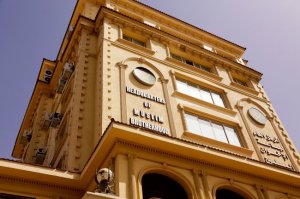
Tamarod’s call for Morsi’s resignation came as protesters stormed the headquarters of the ruling Muslim Brotherhood in Cairo on Monday morning, burning the premises and looting office supplies in the course of a long siege that left at least seven people dead.
30 June – Hundreds of thousands in Cairo for anti-Morsi protest – France24

30/06/2013 – France24

image
Tahrir Square, Cairo

Hundreds of thousands of protesters massed in the streets of Cairo on Sunday to demand Egyptian President Mohammed Morsi’s resignation one year after he first took office.

__________________________
Huge turnout at Egypt’s Presidential Palace protest
__________________________

___________________________

Hundreds of thousands of Egyptians flooded into the streets on the first anniversary of Islamist President Mohamed Mursi’s inauguration on Sunday to demand that he resign.

Waving national flags and chanting “Get out!”, a crowd of more than 200,000 had massed by sunset on Cairo’s central Tahrir Square in the biggest demonstration since the 2011 uprising that overthrew Mursi’s predecessor, Hosni Mubarak.

“The people want the fall of the regime!” they shouted, echoing the Arab Spring rallying cry that brought down Mubarak – this time yelling it not against an ageing dictator but against the first elected leader in Egypt’s 5,000 year recorded history.

Many bellowed their anger at Mursi’s Muslim Brotherhood, accused of hijacking the revolution and using electoral victories to monopolise power and push through Islamic law.

Others have been alienated by a deepening economic crisis and worsening personal security, aggravated by a political deadlock over which Mursi has presided.

As the working day ended and 38 Celsius (100 Fahrenheit) heat eased, more protesters converged through the eerily deserted streets of the shuttered city centre, while smaller crowds protested in several other areas of the capital.

The veteran leaders of Egypt’s secular, liberal and left-wing opposition, including former chief of the U.N. nuclear watchdog Mohamed ElBaradei and leftist presidential candidate Hamdeen Sabahi, joined protest marches in Cairo.

A Reuters journalist said hundreds of thousands of anti-government protesters marched through the Mediterranean port of Alexandria, Egypt’s second city, and a military source reported protests in at least 20 towns around the country.

Mursi, an engineering professor propelled to power by the Muslim Brotherhood, was monitoring events from the heavily guarded Qubba presidential palace, where an official spokesman appealed for the demonstrations to remain peaceful.

“Maintaining the security of Egypt is the common responsibility of everyone,” presidential spokesman Ehab Fahmy told a news conference. “Dialogue is the only way to reach mutual understanding and to reach national agreement around the different issues of our homeland.”

Legitimacy

Security sources said three Brotherhood offices were set on fire by demonstrators in towns in the Nile Delta – the latest in more than a week of sporadic violence in which hundreds have been hurt and several killed, including an American student.

More than 20,000 supporters of Mursi congregated outside a Cairo mosque not far from another suburban presidential palace, where protest organisers planned a sit-in from Sunday evening.

Interviewed by a British newspaper, Mursi voiced his determination to ride out what he sees as an undemocratic attack on his electoral legitimacy. But he also offered to revise the new, Islamist-inspired constitution, saying clauses on religious authority, which fuelled liberal resentment, were not his choice.

He made a similar offer last week, after the head of the army issued a strong call for politicians to compromise. But the opposition dismissed it as too little to late. They hope Mursi will resign in the face of large numbers on the streets.

“We call on Mohamed Mursi, who has completely lost the legitimacy of his power, to quickly respond to the clear will of the people which is plain today in all corners of revolutionary Egypt,” the June 30 movement, which organised a nationwide petition demanding his resignation, said in a statement.

Some Egyptians seem to believe the army might force the president’s hand, if not to quit then at least to make major concessions to the opposition.

In Cairo, demonstrators stopped to shake hands and take photographs with soldiers guarding key buildings. At least six high-ranking police officers took to the Tahrir Square podium in support of demonstrators, a Reuters witness said.

The armed forces used military helicopters to monitor the protests in Cairo and Alexandria and a military source said chief-of-staff and Defence Minister General Abdel Fattah al-Sisi was following the situation from a special operations room.

Mursi and the Brotherhood hope the protests will fizzle like previous outbursts last December and in January. If they do not, some form of compromise, possibly arbitrated by the army, may be on the cards.

Violence

Both sides insist they plan no violence but accuse the other – and agents provocateurs from the old regime – of planning it.

The U.S.-equipped army shows little sign of wanting power but warned last week it may have to step in if deadlocked politicians let violence slip out of control.

U.S. President Barack Obama called for dialogue and warned trouble in the most populous Arab nation could unsettle an already turbulent region. Washington has evacuated non-essential personnel and reinforced security at diplomatic missions.

In an interview with London’s Guardian newspaper, Mursi repeated accusations that what he sees as entrenched interests from the Mubarak era are plotting to foil his attempt to govern. But he dismissed the demands that he give up and resign.

If that became the norm, he said, “well, there will be people or opponents opposing the new president too, and a week or a month later, they will ask him to step down”.

Liberal leaders say nearly half the voting population – 22 million people – has signed a petition calling for new elections, although there is no obvious challenger to Mursi.

The opposition, fractious and defeated in a series of ballots last year, hope that by putting millions on the streets they can force Mursi to relent and hand over to a technocrat administration that can organise new elections.

Army role

Religious authorities have warned of “civil war”. The army insists it will respect the “will of the people”, though the two sides have opposing views of what that means.

Islamists interpret that to mean army support for their election victories. Opponents believe that the army may heed the popular will as expressed on the streets, as it did in early 2011 when the generals decided Mubarak’s time was up.

Having staged shows of force earlier this month, the Brotherhood has not called on supporters to go out on Sunday.

Among the Islamists in Cairo, Ahmed Hosny, 37, said: “I came here to say, ‘We are with you Mursi, with the legitimate order and against the thugs’.

“This is our revolution and no one will take it from us.”

At Tahrir Square, banners ranged from “The Revolution Goes On”, “Out, Out Like Mubarak” to “Obama Backs Terrorism” – a reference to liberal anger at U.S. support for Mursi’s legitimacy and criticism of protests as bad for the economy.

“I am here to bring down Mursi and the Brotherhood,” said Ahmed Ali al-Badri, a feed merchant in a white robe. “Just look at this country. It’s gone backwards for 20 years. There’s no diesel, gasoline, electricity. Life is just too expensive.”

The army, half a million strong and financed by Washington since it backed a peace treaty with Israel three decades ago, says it has deployed to protect key installations.

Among these is the Suez Canal. Cities along the waterway vital to global trade are bastions of anti-government sentiment. A bomb killed a protester in Port Said on Friday. A police general was gunned down in Sinai, close to the Israeli border.

There are some similarities with Turkey, where an Islamist prime minister with a strong electoral mandate was confronted in the streets by angry secularists this month. But Egypt is much poorer, its economy is crumbling rather than booming and its new democracy was born in a revolution just two years ago.

For many Egyptians, all the turmoil since 2011 has just made life harder. Standing by his lonely barrow at an eerily quiet downtown Cairo street market, 23-year-old Zeeka was afraid more violence was coming.

“We’re not for one side or the other,” he said. “What’s happening now in Egypt is shameful. There is no work, thugs are everywhere … I won’t go out to any protest.

“It’s nothing to do with me. I’m the tomato guy.”

Egypt Update: Sexual harassment against women – USA Today post

Egyptian women rising up against sexual harassment

Sarah Lynch, Special for USA TODAY / June 23, 2013

CAIRO – Women here say it crosses class barriers, generations and faiths. It prevails in public buses, trains, streets and homes. It exists online, on university campuses, and in parks, markets, at work and in cafes.

image
(Photo: Khalil Hamra, AP)

STORY HIGHLIGHTS
+ Men pay few penalties for grabbing and groping women in a violent manner
+ 99.3% of Egyptian women surveyed reported experiencing some form of sexual harassment
+ Islamists have blamed victims for their harassment

Sexual harassment of women is epidemic in Egypt, where men pay few penalties for grabbing and groping women in a violent manner.

image
In the film, Cairio 678, one of the lead characters, played by actress Bushra, is repeatedly harassed on bus

The harassment appears to permeate the nation’s every pore, academics say. After decades of such behavior, a growing number of groups and initiatives are working to do something about it.

“For many women who have to rely on walking, public transportation or the metro, it’s a grinding thing that happens every day,” said Helen Rizzo, associate professor of sociology at the American University in Cairo.

“For some women, it’s been very serious: grabbing, touching, trying to pull women into cars, and the whole phenomena of attacking protests,” she said.

A recent report by U.N. Women said 99.3% of Egyptian women surveyed in a recent study reported experiencing some form of sexual harassment — everything from inappropriate sexual jokes, to whistling, touching, groping and rape.

“Through this study we are able to confirm the spread of sexual harassment in Egypt to unprecedented levels,” stated the U.N. report.

Some believe the problem has grown worse since the 2011 revolution that ousted dictator Hosni Mubarak and led to a government under Muslim Brotherhood rule, perhaps due to a drop in effective security.

“Certainly sexual harassment and sexual assault and violent attacks are something not new in Egypt,” said Diana Eltahawy, Amnesty International’s Egypt researcher, noting that under Mubarak they were used as tools to repress women.

The survey is striking for the sheer range of places where women feel they can be victimized.

Almost 83% of surveyed women said they don’t feel safe in the street and 79% don’t feel safe in a taxi. Sixty-seven percent said girls are subject to harassment regardless of what they wear, how they look, their manner of speech or their gait. Female workers and students are most exposed to harassment.

Brutality in the public space now has symbolic value for the nation too, Eltahawy said. Vicious mob attacks and assault happen often in Tahrir Square, the heart of that nation’s uprising where men and women joined and camped out for days to demand democratic freedoms and a fair justice system.

An organization called HarassMap founded in 2010, allows women to report locations of abuse using technology. Through advertising on television, radio, in music and print the group seeks to change perceptions associated with harassment and remind the public it is a punishable offense.

While the law doesn’t explicitly criminalize sexual harassment, three laws that address rape, public indecency and assault can be applied to harassment cases.

“It’s all about culture and misconceptions,” said Dina Samir, communications manager at HarassMap, who says harassment has worsened over the last decade. “If the culture changes it would put pressure on the government to enforce laws.”

“We believe we can play a big role in changing perceptions,” she said.

Men are also getting involved because “it’s not just a women’s issue,” said Ayman Nagy, who founded the Anti-Harassment Movement. “It’s a humanity issue.”

Nagy and a group of 73 full-time volunteers hold workshops in universities and even in the streets among other places to talk about issues that include sexual abuse.

“We need to solve the problem from its roots,” Nagy said. “We’re going to work on the harasser himself, because we think he is a sick person and needs help, and that we can help him.”

Other groups such as Operation Anti-Sexual Harassment seek to end mob harassment and assault, and Tahrir Bodyguard has a team of volunteers in bright green vests who intervene when they see sexual violence taking place during protests.

In March, President Mohammed Morsi launched an effort to help identify challenges facing women through workshops, fieldwork and discussions. Last month, local press reported that the government created an all-female unit of police to battle sexual harassment.

“Time will tell whether or not these are serious attempts, and also whether or not they are going to bring about real changes and results the way grass-roots movements have been able to do,” said Soraya Bahgat, who founded Tahrir Bodyguard and is now working more generally on women’s issues.

Not all groups, however, are on board with efforts to empower women and Islamists have blamed victims for their harassment.

Earlier this year the powerful Muslim Brotherhood condemned a United Nations report meant to reduce violence against women. The Brotherhood criticized articles in the document that gave judges, rather than husbands, authority in cases of divorce and granted women full rights to file legal complaints against their husbands for rape or sexual harassment.

“The document includes articles that contradict established principles of Islam, undermine Islamic ethics and destroy the family,” the Muslim Brotherhood said in a statement.

Despite challenges, activists persist, although their efforts have not led to a measurable drop in harassment.

“We cannot say it has decreased because of our work but the positive side is that it has become less of a taboo and so many activists and initiatives are working on the topic,” HarassMap’s Samir said. “These are the only glimmers of hope.”

Photo Essay: The Muslim Brotherhood Has Turned Cairo Into A Dystopia – Re-Blog

Peanut Gallery: Once again Photo Essayist Robert Johnson has lifted the veil of Cairo and exposed the shattered dreams of the “Arab Spring”… now a long winter under the Muslim Brotherhood. Will they ever recover? Not likely in any foreseeable future.

Please follow the link below to Johnson’s essay posted at Business Insider. The photos tell all….
___________________________

The Muslim Brotherhood Has Turned Cairo Into A Dystopia [PHOTOS]

by Robert Johnsonbusinessinsider.com / May 23rd 2013 12:55 PM

Robert Johnson/Business Insider

When Egyptians took to the streets to overthrow an oppressive government in 2011, the world was on their side. But in the two years that followed, as Arab Spring turned to Arab Winter, and Egyptians fell under the rule of the oppressive new government of Mohammed Morsi and the Muslim Brotherhood, the world has looked away.

This is what Egyptians told us when we visited Cairo at the end of March 2013.

Many disillusioned Egyptians say things are worse than ever. Thugs often run the streets, crime rates have skyrocketed, and police feel they’re outgunned, faced with the flood of weapons filling Cairo’s streets. Making matters worse, everything from utilities to gasoline is both more expensive and more difficult to acquire than it was before the Muslim Brotherhood.

Click here to see what has become of Cairo >

Photo Essay Re-Blog: Easter Dinner With A Muslim Family In Dar el-Salam – Robert Johnson

Peanut Gallery: Egypt is in turmoil… it has been for a long time. But now, the world is watching. The news is filled with stories of political unrest, violence, persecution and international forces jockeying for position and influence. But what about ordinary Egyptian people (mostly muslim)… the poor people who do not make news headlines and are just trying to get a life – such as it is.

Robert Johnson, in this photo essay gives us a rare insight into the lives of these ordinary people. For more of Johnson’s photo-journal insights on Egypt – click here.
___________________________________

My Extraordinary Easter Dinner With A Muslim Family From One Of The Poorest Cities In Egypt

Robert Johnson | Apr. 1, 2013, 7:20 AM

Read more: http://www.businessinsider.com/easter-dinner-in-dar-el-salam-2013-4#ixzz2PazWniwM

When a man I met on Friday invited me to his family’s home for Sunday dinner, it was an uncommon offer. When the invitation turned out to be in Dar el-Salam, one of Egypt’s most poverty stricken areas, Easter afternoon turned into a once-in-lifetime affair.

The road to Dar el-Salam is dirt and a crest of smoldering refuse lines the middle of it, picked over by cats, dogs, burros, kids, and collectors trying to bring home any money they can. It took four attempts to find a cab driver willing to take us. When we arrived, the man who invited me, Hani, sat with a group of 10 or so other men at an outdoor cafe. A small part of the local mafia family, he said he’d grown up beside them and they specialized in “whatever makes them money.”

From what I could tell their enterprise includes drugs and theft, but whatever it is offers them neighborhood wide-respect. They took me to a place I couldn’t have imagined and perhaps no one from the outside could have gone without a personal escort from them, definitely not an American with two big noisy cameras.

Back through the dusty, narrow alleys, past broken-down billiard tables shoved into mud brick rooms, haphazard grocery stores, and untold apartments, we came to a dead end.

A massive bed of gravel and rock led to a sheer cliff wall and the skeletal remains of apartments destroyed by the last rock slide.

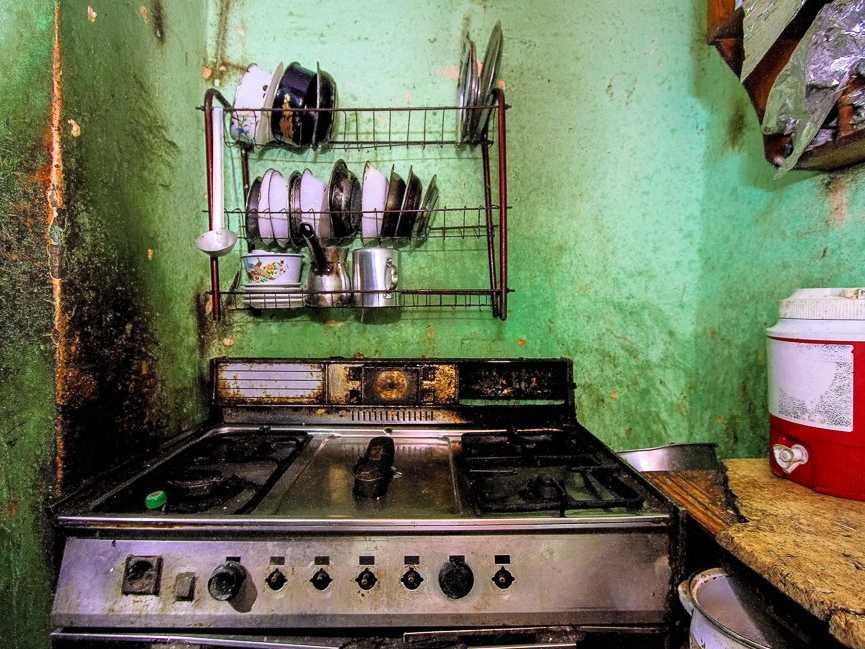
dar-el-salam-2The families whose homes they took me into were unlike anything I’d ever seen, and far from hiding the situation they were in, the residents let me stomp into their home because they wanted to let the world know how they lived. They’d appreciate a bit of help from the new government, just picking up the trash would be a nice start, they said.

I’ve yet to meet someone happy with the results of the revolution and these people were no different. Their neighborhood started to slide about eight years ago, and has gotten dramatically worse in the past couple of years. Water bills have nearly doubled, rents have gone up and incomes way down.

One Muslim family of seven sleeping in a subterranean room invited us to stay for Easter dinner. An incredibly gracious offer we had to decline, as we made our way to Hani’s father’s apartment.

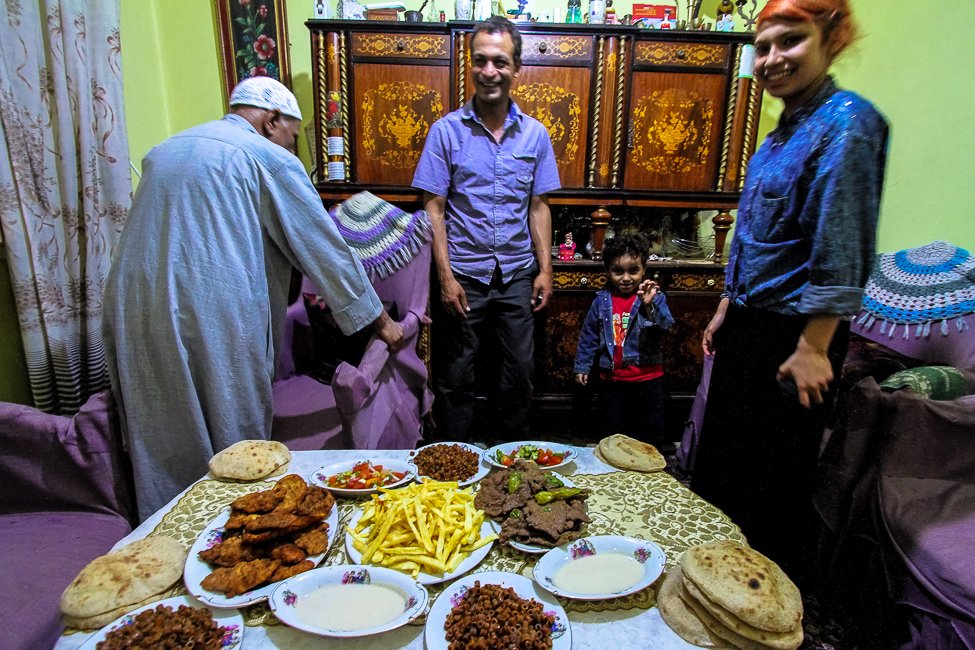
Dinner was on the table when we arrived. A big plate of French fries and a new bottle of Ketchup sat before the seat of honor, the middle of the couch where I was directed.
There’s just enough to get by on now, barely. When people like this can no longer feed their kids, they’ll have nothing to lose. Already they pine for the days of former president Mubarak.

Here are a few pictures from the visit. I’ll post a longer feature on the experience next week.

Robert Johnson/Business Insider

dar el-salam-17They did not have much, but they were all smiles and offering to share.

Robert Johnson/Business Insider

dar el-salam-20Washroom off the kitchen

Robert Johnson/Business Insider

dar el-salam-10Stairs

Robert Johnson/Business Insider

dar el-salam-13Without enough money, women are forced to share the same space as the men

Robert Johnson/Business Insider

dar el-salam-33Easter dinner, with French fries and Ketchup for the first American they’ve met

Robert Johnson/Business Insider

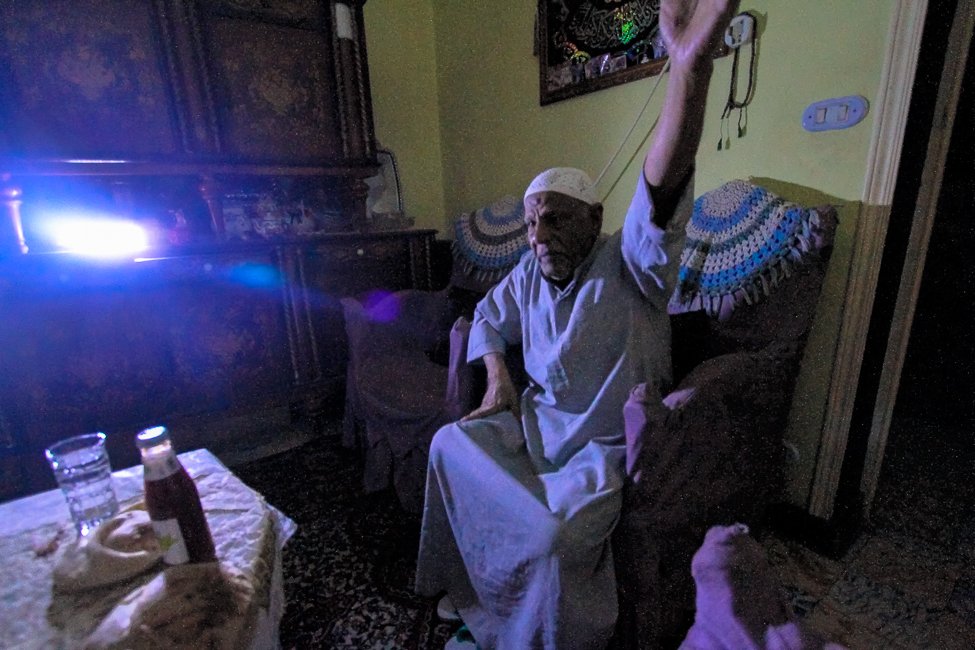
dar el-salam-35And then power went off, my host said it’s because president Morsi is selling electricity to Gaza. And charging 30 percent more than it cost under the former president.

Read more: http://www.businessinsider.com/easter-dinner-in-dar-el-salam-2013-4#ixzz2PavhPaQ1