Urgent request to pray for Christians in Egypt

Supporters of Egypt's ousted President Mohammed Morsi chant slogans against the military near Cairo University in Giza, Egypt, Monday, July 8, 2013. Photograpehr: Manu Brabo/AP Photo
Supporters of Egypt’s ousted President Mohammed Morsi chant slogans against the military near Cairo University in Giza, Egypt, Monday, July 8, 2013. Photograpehr: Manu Brabo/AP Photo

Peanut Gallery: The news out of Egypt is not good. Millions of Egyptians took to the streets demanding that Islamist President Morsi step down. He didn’t… and the Egyptian Army stepped in. Egyptian Christians have generally (although not officially) aligned themselves with the anti-Morsi forces.

But Morsi and the Muslim Brotherhood are not finished yet. They have called for a counter-revolution and have taken to the streets. The result has been further chaos with shootings, military arrests and crackdown, accusations, and counter-accusations. A Coptic priest was killed by Islamists in Northern Sinai. Only God knows how it will end.

No matter who wins this current struggle for power, Egypt is a failed state and Coptic Christians live in great peril.

Egyptians civil servants are waiting in line for hours in front of these subsidized bakeries. Fights break out often, says a reporter from NPR covering the story this morning. Prices at unregulated bakers run around 8 cents per loaf… eight times the cost of the price at the government-supported stands.

Egypt cannot feed its own people, cannot supply adequate fuel, cannot borrow money (virtually bankrupt), cannot employ its teeming masses, and Egyptian tourism has shrunk to nothing. The vast majority of people live in abject poverty. There is no quick fix and no one seems to have a long range economic plan.

Mina Aboud Sharweem
Mina Aboud Sharweem

Coptic Christians have been brutalized under the Morsi regime – either by design or neglect. Pope Tawadros II has criticized the regime’s treatment of Christians without much success, i.e. until the current overthrow of Morsi and the Muslim Brotherhood. Now Christians are aligned with the anti-Morsi forces and they will be easy targets for Islamist revenge. As mentioned a Coptic priest ( Mina Aboud Sharweem) has already been killed in a sectarian murder.

But Egypt’s problems go way beyond socio-economic and sectarian analysis.

Gang-rape of Egyptian woman in Tahrir Square

Egypt have serious, wide-spread misogyny problems. It’s not about veils or coverings – it’s about wide-spread gang rape in public spaces, the widespread practice of female genital mutilation at puberty, the kidnapping of young Christian girls by Islamists with forced marriages to older men, the practice of marriage to pre-pubescent girls as young as 8 or 9. There is something fundamentally wrong with a society that treats women (created in the image of God) like that.

Below, please find an earlier post from Open Doors UK requesting urgent prayer. That was a week ago and the situation has changed dramatically for the worse. Christians in Egypt desperately need our prayer. One Coptic brother in Christ write:

Psalm 33 has been one of the very encouraging words and promises for us as a church and we read it publicly many times, especially verses 9-11, ‘For He spoke, and it was done; He commanded, and it stood fast. The Lord brings the counsel of the nations to nothing; He makes the plans of the peoples of no effect. The counsel of the Lord stands forever, the plans of His heart to all generations’.

“We ask you to join us in praying that His name would be known and glorified in Egypt (Isaiah 19:21).”

_______________________________________

OUT OF EGYPT – Open Doors UK / 2 July 2013

With millions on the streets in Cairo, celebrating the army’s 48 hour ultimatum, Christians have been gathering night after night to pray for peace.

Army ultimatum

An Egyptian Christian brother in Cairo told us, “Last night (July 1), millions rejoiced and shouted in streets and squares until early morning today, celebrating the clear pronouncement directed to President Morsi and the Muslim Brotherhood ruling party, that the army has again decided to take the side of the people rather than the rulers.”

President Morsi, however, has said the 48 hour army ultimatum ‘may cause confusion’ and vows to stick to his own plans to resolve the political crisis.

10 days of prayer for Egypt

Meanwhile, in a large church in the centre of Cairo, Christians have just concluded 10 days of prayer for Egypt. One church member told us:

“Around 800-1000 gathered every night from 7.00-9.00pm to cry out on behalf of our nation. We prayed mainly for the protection and peace of Egypt. We also prayed for a fresh outpouring of the Holy Spirit and for a revival and great harvest in Egypt. Psalm 33 has been one of the very encouraging words and promises for us as a church and we read it publicly many times, especially verses 9-11, ‘For He spoke, and it was done; He commanded, and it stood fast. The Lord brings the counsel of the nations to nothing; He makes the plans of the peoples of no effect. The counsel of the Lord stands forever, the plans of His heart to all generations’.

“We ask you to join us in praying that His name would be known and glorified in Egypt (Isaiah 19:21).”

Source: Open Doors; BBC

10 Things Every Christian Should Know About Islam – reblog

thegospelcoalition.org / Jul 5th 2013

Islam is a fast-growing religion, especially in the Western world. Christians increasingly need to be aware of Islam and, most importantly, how to engage its adherents with the gospel of Jesus Christ. Here are 10 things I learned about Islam during my 20 years as a missionary in a Muslim-majority country.

1. “Muslim” and “Arab” are not the same thing.

“Muslim” is a religious term. A Muslim is someone who adheres to the religion of Islam. “Arab,” on the contrary, is an ethno-linguistic term. An Arab is a member of the people group who speak the Arabic language. It is true that Islam originated among the Arabs, and the Qur’an was written in Arabic. However, some Arabs have historically been part of the ancient orthodox Christian churches. On the other hand, Islam spread far beyond the Arab world, and today most Muslims are not Arabs. This includes the Turks, the Kurds, the Iranians, the Pakistanis, other South Asian Muslims, the Malaysians and the Indonesians, almost all of whom are Muslim but none of whom is Arab.

2. The word “Islam” means submission.

A Muslim is someone who submits to God. The Islamic conception of who God is, and how he is to be worshiped and served, is based on the teaching of Muhammad. Thus the Islamic creed is: “There is no God but God, and Muhammad is his prophet.”

3. There are two major denominations of Muslims.

The two major denominations of Muslims are Sunni and Shi’a. Sunnis are the vast majority, at 85 percent of all Muslims. The split occurred in the first generation after Muhammad’s death and was based on a dispute over who should succeed him as leader of the Islamic community.

4. Islamic theology could be summarized as belief in one God, his prophets, his books, his angels, his decrees, and the final judgment.

Islam teaches that humans are born spiritually neutral, perfectly capable of obeying God’s requirements completely, and that they remain this way even after they’ve personally sinned. The need of humanity, therefore, is not salvation but instruction; hence Islam has prophets, but no savior.

5. Islam teaches that Jesus was a great prophet.

Islam affirms that Jesus was born of a virgin, that he lived a sinless life, that he performed mighty miracles, and that he will come again at the end of history. It even calls him a word from God. However, it explicitly denies the deity of Christ and repudiates the title “Son of God” as blasphemous. It also (according to the majority view) denies he died on the cross, claiming that Jesus’ visage was imposed on someone else, who was then crucified, and that Jesus was taken up into heaven without tasting death. Islam explicitly denies the possibility of substitutionary atonement.

image
Kaaba Shrine in Mecca, Saudi Arabia

6. Islamic practice can be summarized by the Five Pillars of Islam.

These are composed of the confession of faith (“There is no God but God, and Muhammad is his prophet”), prayer (the ritual prayers said in Arabic five times a day while facing Mecca and performing the prescribed set of bowings, kneeling, and prostrations), alms (taken as a tax in some officially Islamic countries), fasting (the lunar month of Ramadan, during which Muslim believers fast during daylight hours but can eat while it’s dark), and pilgrimage (the Hajj, or pilgrimage to Mecca, which every Muslim believer should make once in his or her lifetime).

7. The vast majority of Muslims are not terrorists.

In fact, normal Islamic religious law forbids the intentional killing of non-combatants in battle. It also forbids suicide. It’s a small minority view that allows these things, and it’s a small minority who engage in terrorist activities.

8. Muslims can be some of the friendliest, most hospitable people on earth.

They make great neighbors and great friends. No Christian should be afraid to build a relationship with a Muslim.

9. Muslims need salvation through Jesus Christ.

They are lost exactly like any other non-Christian—neither more nor less than anyone else. Furthermore, Muslims do come to faith in Jesus Christ. It usually takes time, and extended exposure to the Word of God and the lives of Christians, but more Muslims are coming to faith today than at any other point in history.

10. God loves Muslims, and so should we—even those few who are our enemies.

We should love them enough to befriend them, love them enough to make them welcome in our homes, and love them enough to share the gospel with them.

This article originally appeared in the Summer 2013 issue of Southern Seminary Magazine.

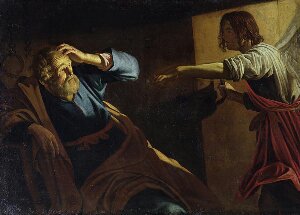
Morning Reading: Acts 12.6-19 NLT – prison break

Reading: Acts 12:6-19 NLT

The night before Peter was to be placed on trial, he was asleep, fastened with two chains between two soldiers. Others stood guard at the prison gate.

image
St Peter Being Freed from Prison
Gerrit van Honthorst (1616-1618)

Suddenly, there was a bright light in the cell, and an angel of the Lord stood before Peter. The angel struck him on the side to awaken him and said, “Quick! Get up!” And the chains fell off his wrists. Then the angel told him, “Get dressed and put on your sandals.” And he did. “Now put on your coat and follow me,” the angel ordered.

So Peter left the cell, following the angel. But all the time he thought it was a vision. He didn’t realize it was actually happening.

They passed the first and second guard posts and came to the iron gate leading to the city, and this opened for them all by itself. So they passed through and started walking down the street, and then the angel suddenly left him.

Peter finally came to his senses. “It’s really true!” he said. “The Lord has sent his angel and saved me from Herod and from what the Jewish leaders had planned to do to me!”

When he realized this, he went to the home of Mary, the mother of John Mark, where many were gathered for prayer. He knocked at the door in the gate, and a servant girl named Rhoda came to open it.

When she recognized Peter’s voice, she was so overjoyed that, instead of opening the door, she ran back inside and told everyone, “Peter is standing at the door!”

“You’re out of your mind!” they said. When she insisted, they decided, “It must be his angel.”

Meanwhile, Peter continued knocking. When they finally opened the door and saw him, they were amazed.

He motioned for them to quiet down and told them how the Lord had led him out of prison. “Tell James and the other brothers what happened,” he said. And then he went to another place.

At dawn there was a great commotion among the soldiers about what had happened to Peter. Herod Agrippa ordered a thorough search for him. When he couldn’t be found, Herod interrogated the guards and sentenced them to death. Afterward Herod left Judea to stay in Caesarea for a while.

Prayer: Heavenly Father – Why is it that we pray for divine intervention, but never really expect it. Forgive our unbelief and small faith. Lord Jesus – Align us with your Kingdom purposes so that we might pray with boldness and conviction. Holy Spirit – Open our hearts and minds to all the miraculous possibilities that you work among us. Make us faithful in prayer and humble in spirit… trusting you for outcomes befitting your perfect will. Amen.

Hymn: “Sweet Hour of Prayer”W.W. Walford (1772-1850)

_______________________

Sweet hour of prayer! sweet hour of prayer! That calls me from a world of care, and bids me at my Father’s throne make all my wants and wishes known.  In seasons of distress and grief, my soul has often found relief, and oft escaped the tempter’s snare by thy return, sweet hour of prayer!

Sweet hour of prayer! sweet hour of prayer! The joys I feel, the bliss I share of those whose anxious spirits burn with strong desires for thy return! With such I hasten to the place where God my Savior shows his face, and gladly take my station there, and wait for thee, sweet hour of prayer!

Sweet hour of prayer! sweet hour of prayer! Thy wings shall my petition bear to him whose truth and faithfulness engage the waiting soul to bless. And since he bids me seek his face, believe his word, and trust his grace, I’ll cast on him my every care, and wait for thee, sweet hour of prayer!