Afterward he ate some food and regained his strength.
Saul stayed with the believers in Damascus for a few days. And immediately he began preaching about Jesus in the synagogues, saying, “He is indeed the Son of God!”
All who heard him were amazed. “Isn’t this the same man who caused such devastation among Jesus’ followers in Jerusalem?” they asked. “And didn’t he come here to arrest them and take them in chains to the leading priests?”
Saul’s preaching became more and more powerful, and the Jews in Damascus couldn’t refute his proofs that Jesus was indeed the Messiah.
After a while some of the Jews plotted together to kill him. They were watching for him day and night at the city gate so they could murder him, but Saul was told about their plot. So during the night, some of the other believers lowered him in a large basket through an opening in the city wall.
Prayer: Lord Jesus – Give your servants the courage and power to proclaim you as the Son of God, the Messiah… our Savior and Lord. In season, or out of season, may we be ready to give a persuasive and passionate account of the hope that we have found in you. Amen.
Spiritual Song:“Come to Jesus for Salvation” – Cornerstone Church
Sarah Lynch, Special for USA TODAY / June 23, 2013
CAIRO – Women here say it crosses class barriers, generations and faiths. It prevails in public buses, trains, streets and homes. It exists online, on university campuses, and in parks, markets, at work and in cafes.
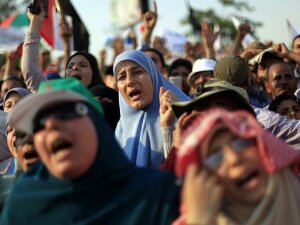
(Photo: Khalil Hamra, AP)
STORY HIGHLIGHTS
+ Men pay few penalties for grabbing and groping women in a violent manner
+ 99.3% of Egyptian women surveyed reported experiencing some form of sexual harassment
+ Islamists have blamed victims for their harassment
Sexual harassment of women is epidemic in Egypt, where men pay few penalties for grabbing and groping women in a violent manner.
In the film, Cairio 678, one of the lead characters, played by actress Bushra, is repeatedly harassed on bus
The harassment appears to permeate the nation’s every pore, academics say. After decades of such behavior, a growing number of groups and initiatives are working to do something about it.
“For many women who have to rely on walking, public transportation or the metro, it’s a grinding thing that happens every day,” said Helen Rizzo, associate professor of sociology at the American University in Cairo.
“For some women, it’s been very serious: grabbing, touching, trying to pull women into cars, and the whole phenomena of attacking protests,” she said.
A recent report by U.N. Women said 99.3% of Egyptian women surveyed in a recent study reported experiencing some form of sexual harassment — everything from inappropriate sexual jokes, to whistling, touching, groping and rape.
“Through this study we are able to confirm the spread of sexual harassment in Egypt to unprecedented levels,” stated the U.N. report.
Some believe the problem has grown worse since the 2011 revolution that ousted dictator Hosni Mubarak and led to a government under Muslim Brotherhood rule, perhaps due to a drop in effective security.
“Certainly sexual harassment and sexual assault and violent attacks are something not new in Egypt,” said Diana Eltahawy, Amnesty International’s Egypt researcher, noting that under Mubarak they were used as tools to repress women.
The survey is striking for the sheer range of places where women feel they can be victimized.
Almost 83% of surveyed women said they don’t feel safe in the street and 79% don’t feel safe in a taxi. Sixty-seven percent said girls are subject to harassment regardless of what they wear, how they look, their manner of speech or their gait. Female workers and students are most exposed to harassment.
Brutality in the public space now has symbolic value for the nation too, Eltahawy said. Vicious mob attacks and assault happen often in Tahrir Square, the heart of that nation’s uprising where men and women joined and camped out for days to demand democratic freedoms and a fair justice system.
An organization called HarassMap founded in 2010, allows women to report locations of abuse using technology. Through advertising on television, radio, in music and print the group seeks to change perceptions associated with harassment and remind the public it is a punishable offense.
While the law doesn’t explicitly criminalize sexual harassment, three laws that address rape, public indecency and assault can be applied to harassment cases.
“It’s all about culture and misconceptions,” said Dina Samir, communications manager at HarassMap, who says harassment has worsened over the last decade. “If the culture changes it would put pressure on the government to enforce laws.”
“We believe we can play a big role in changing perceptions,” she said.
Men are also getting involved because “it’s not just a women’s issue,” said Ayman Nagy, who founded the Anti-Harassment Movement. “It’s a humanity issue.”
Nagy and a group of 73 full-time volunteers hold workshops in universities and even in the streets among other places to talk about issues that include sexual abuse.
“We need to solve the problem from its roots,” Nagy said. “We’re going to work on the harasser himself, because we think he is a sick person and needs help, and that we can help him.”
Other groups such as Operation Anti-Sexual Harassment seek to end mob harassment and assault, and Tahrir Bodyguard has a team of volunteers in bright green vests who intervene when they see sexual violence taking place during protests.
In March, President Mohammed Morsi launched an effort to help identify challenges facing women through workshops, fieldwork and discussions. Last month, local press reported that the government created an all-female unit of police to battle sexual harassment.
“Time will tell whether or not these are serious attempts, and also whether or not they are going to bring about real changes and results the way grass-roots movements have been able to do,” said Soraya Bahgat, who founded Tahrir Bodyguard and is now working more generally on women’s issues.
Not all groups, however, are on board with efforts to empower women and Islamists have blamed victims for their harassment.
Earlier this year the powerful Muslim Brotherhood condemned a United Nations report meant to reduce violence against women. The Brotherhood criticized articles in the document that gave judges, rather than husbands, authority in cases of divorce and granted women full rights to file legal complaints against their husbands for rape or sexual harassment.
“The document includes articles that contradict established principles of Islam, undermine Islamic ethics and destroy the family,” the Muslim Brotherhood said in a statement.
Despite challenges, activists persist, although their efforts have not led to a measurable drop in harassment.
“We cannot say it has decreased because of our work but the positive side is that it has become less of a taboo and so many activists and initiatives are working on the topic,” HarassMap’s Samir said. “These are the only glimmers of hope.”



 The Peanut Gallery