Re-blog: “Seven Traits of the Christian Man”

Peanut Gallery: What makes a Christian man? It’s an odd question to be asking in the 2013th  year of Christendom. You’d think we’d have it worked out by now.

imageOn the other hand, every generation has to learn essential Christian truths themselves. And in a post-Christian world, the teaching of basic, essential Judeo-Christian truths is all the more important… since there’s little chance of picking anything up by societal osmosis.

Roderick Evans offers some practical advice for men wanting to live Christian lives. It’s not a theological treatise and it’s not the last word on the subject, but it contains good practical guidance. It’s a good starting point.

I’d welcome any additional resources that you think might be useful. God bless.
________________________________

Defining the Christian Male – Seven Traits of the Christian Man

January 7th 2011

by Poet, roderickevans.net

Every Christian male should ask himself this question: What makes me a man? More importantly, what makes me a godly man? If a man does not know who he is, he will not be all he can be in Christ Jesus. The Christian male has to understand that he can only define himself based upon biblical standards.

This is because culture and Christianity have varying viewpoints about what makes one a “man.” The Christian male, then, has to learn to define his manhood in terms of his relationship with Christ (righteousness and character), rather than by the culture (which focuses mostly on external traits -strength, money, stature, family, etc). Before going further the Christian male should understand:

*A man’s definition is not based upon external characteristics, but internal traits.*

*The Definition of a man is found in the image of God.*

*Culture cannot define a man.*

With this understanding, we want to offer seven primary qualities or traits of the Christian man.

1. He reflects Christ’s image. As Adam was made in God’s image, the Christian man has to be made in Christ’s image. He will reflect the characteristics of Christ. (Romans 8:29)

2. He is a man full of wisdom and integrity. The Christian man will not be a fool. He will not lack spiritual wisdom and insight. He will be full of faith. (Acts 6:3a)

3. His is an example of the believers in this world. The Christian man will set an example that others can follow. He will represent the Christian faith well to the world. (I Timothy 4:12b)

4. He leads his home in the worship of God. One of the qualifications for a bishop was to have his home in order. This same quality will be in the true Christian man. (I Timothy 3:4)

5. He follows the example that Christ set. Paul exhorted the Corinthians to follow his example as he followed Christ. This will be the same desire of the Christian man. He will only want others to emulate him as he follows Christ. (I Corinthians 11:1)

6. He is man of prayer. In the Old Testament, men offered the most powerful prayers. Contrary to popular belief, women are not more effective in prayer than men. Prayer is not woman’s work. Men have a responsibility to weep and mourn and intercede for others also. (Ephesians 6:18)

7. He is a student of the Word of God. The Christian man will have a desire to know God’s word. He will not shun corporate and personal study of the Word. He will also understand the foundational beliefs of the Christian faith. (II Timothy 2:15)

Well, there you have it! Until next time, stand in the faith. Faithful is Christ who will be with us in the life and in the one that is to come. I have addressed this topic in detail in my book “What is Man? – Defining the Christian Male” which can found at Amazon.com.

Morning Readings: Luke 2,3,4 – the making of a Man

"Jesus Teaching in the Synagogue"Illustration for the Life of Christ', C.1886-94By James Jacques Joseph Tissot|
“Jesus Teaching in the Synagogue”
Illustration for the Life of Christ’, C.1886-94
By James Jacques Joseph Tissot

Reading: Luke 2.39-40 NLT

When Jesus’ parents had fulfilled all the requirements of the law of the Lord, they returned home to Nazareth in Galilee. There the child grew up healthy and strong. He was filled with wisdom, and God’s favor was on him.

Reading: Luke 2.41-47 NLT

Every year Jesus’ parents went to Jerusalem for the Passover festival. When Jesus was twelve years old, they attended the festival as usual. After the celebration was over, they started home to Nazareth, but Jesus stayed behind in Jerusalem. His parents didn’t miss him at first, because they assumed he was among the other travelers. But when he didn’t show up that evening, they started looking for him among their relatives and friends.

When they couldn’t find him, they went back to Jerusalem to search for him there. Three days later they finally discovered him in the Temple, sitting among the religious teachers, listening to them and asking questions. All who heard him were amazed at his understanding and his answers.

Reading: Luke 2.51-52 NLT

Then he returned to Nazareth with them and was obedient to them. And his mother stored all these things in her heart. Jesus grew in wisdom and in stature and in favor with God and all the people.

Reading: Luke 3.21-23 NLT

One day when the crowds were being baptized, Jesus himself was baptized. As he was praying, the heavens opened, and the Holy Spirit, in bodily form, descended on him like a dove. And a voice from heaven said, “You are my dearly loved Son, and you bring me great joy.” Jesus was about thirty years old when he began his public ministry.

Reading: Luke 4.1-2 NLT

Then Jesus, full of the Holy Spirit, returned from the Jordan River. He was led by the Spirit in the wilderness, where he was tempted by the devil for forty days.

Reading: Luke 4.14-15 NLT

Then Jesus returned to Galilee, filled with the Holy Spirit’s power. Reports about him spread quickly through the whole region. He taught regularly in their synagogues and was praised by everyone.

RE-Blog: “5 Moral Boundaries You Do Not Want To Cross” by John Hawkins

Peanut Gallery: Today’s reading from Luke 3 on the “Temptation of Jesus,” reminded me of this post by John Hawkins. The temptation to cross moral boundaries lies at the heart of our very human struggle with sin. Hawkins’ article gives us some stop signs to watch out for.
________________________________________

5 Moral Boundaries You Do Not Want To Cross by John Hawkins (December 9, 2012)  (click here for original article posted in pjmedia.com)

“Man is the cruelest animal.” — Friedrich Nietzsche

“To understand evil, we must set aside the comfortable belief that we would never do anything wrong. Instead, we must begin to ask ourselves, what would it take for me to do such things? Assume that it would be possible.” — Roy Baumeister

Many people consider monsters like Adolf Hitler and Joseph Stalin somehow uniquely evil. They imagine them as malevolent, abominable, nearly inhuman entities who spent their days scheming to inflict misery on other humans for the sheer sadistic pleasure of it.

Mosaic on the vault (Detail of the Hell Scene), Baptistery, Florence.

The truth is much more terrifying: human beings as evil and ruthless as Hitler, Stalin, and Mao are so common that we pass them on the street daily, see them on TV, and may even have the misfortune of knowing them personally. The real difference between these notorious butchers and the guy in a federal prison is not so much the degree of depravity, but the unchecked power needed to make his darkest desires reality.

Once you set aside Hollywood’s caricatured portrait of evil and accept the normalcy of villainy, you see how a “normal person” just like you or me could embrace evil. Moreover, sometimes the shift from human to fiend can have murky beginnings. Some people step over a line and come back. Others follow that tragic path described by C.S. Lewis,

The safest road to Hell is the gradual one — the gentle slope, soft underfoot, without sudden turnings, without milestones, without signposts.

Here, at least, are a few signposts that will alert you to stop, pause, and take stock to make sure you’re not on that gentle slope. Continue reading “RE-Blog: “5 Moral Boundaries You Do Not Want To Cross” by John Hawkins”

Morning Reading: Luke 4:1-2, 13 ESV – temptation

Reading: Luke 4:1-2, 13 ESV

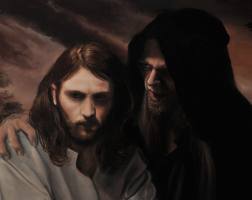
temptation of christ
“Temptation of Christ” – 2011
by Eric Armusik

“And Jesus, full of the Holy Spirit, returned from the Jordan and was led by the Spirit in the wilderness for forty days, being tempted by the devil…..

And when the devil had ended every temptation, he departed from him until an opportune time.”

Reading: Hebrews 4.14-16 NLT

“So then, since we have a great High Priest who has entered heaven, Jesus the Son of God, let us hold firmly to what we believe. This High Priest of ours understands our weaknesses, for he faced all of the same testings we do, yet he did not sin. So let us come boldly to the throne of our gracious God. There we will receive his mercy, and we will find grace to help us when we need it most.”

Prayer: Lord Jesus Christ, Son of God, have mercy on me… a sinner. Write your Word on my heart today. And lead me not into temptation, but deliver me from evil. Amen.

“I’m proud of you!”

Luke 3:22b NLT – And a voice from heaven said, “You are my dearly loved Son, and you bring me great joy.”

Peanut Gallery: Jesus was a “blessed child.” At both His Baptism and Transfiguration, the Father made a special point of expressing His approval… the Father blessed His Son.

father blesses son israeliThis blessing – “you’re my child and I’m proud of you” – is something we all yearn for. We want it at the end of life from our heavenly Father. And we want it during our lifetime from our earthly fathers.

It’s that earthly blessing that I’m thinking about here… and many of us never receive it.

One of the saddest recent Christmas stories came out of England:

When it comes to Christmas, it might be safe to assume children will ask Santa for an extensive list of toys, games and treats.

But a survey of their typical lists for Father Christmas has shown many have more serious concerns, requesting “a dad” instead…..

Despite their material requests, the tenth most popular Christmas wish on the list was a “Dad”.

For those of us who have/had loving, encouraging, supportive dads, the gain is immeasurable. For those of us who haven’t, the loss is enormous… it’s a hole in us that we long to fill.

If this unfilled longing resonates with you – or if you wonder how you can bless your children and grandchildren – I commend the book, The Blessing, by Trent and Smalley to you. It provides guidance for families seeking to bless their children following a Biblical model. And it provides healing and help for those of us who have been “looking for love in all the wrong places. “

At a family gathering a few years ago – our 2 kids, their spouses, and 8 grandchildren – we made a special effort to bless our family.

While they all watched, we singled out each of our kids and their spouses, laid hands on them and told them what we saw in them that made them special to us… and how proud we were of them. Then we asked them to do the same for each one of their children. We all prayed together and then had a fun and games evening.

Our kids are spread around the world now, but we continue the practice with them – and now our grandkids – whenever we can.

“A family blessing begins with meaningful touching. It continues with a spoken message of high value, a message that pictures a special future for the individual being blessed, and one that is based on an active commitment to see the blessing come to pass.”

Dr. Gary Smalley;Dr. John Trent. The Blessing (p. 30). Kindle Edition.

Check out Trent and Smalley’s book – The Blessing – there’s even a workbook available for anyone who wants to go deeper. You and your family will all be the better for it.